
Key findings
ChatGPT does not answer "who should I use for X" from memory. It rewrites your question into targeted search queries and reads the live web.
We captured the exact queries it generated, the roughly 25 sites it read for one question, and the source behind each business it recommended.
Where your information comes from depends on your market. For a niche business, ChatGPT pulled the answer straight from the business's own website. For a saturated market, it leaned on Google Maps listings (ratings and review counts) and third-party "best of" lists.
The recommended set is stable but not identical across runs. Being recommended is a position you can earn, not luck.
ChatGPT and Perplexity recommended almost entirely different companies for the same question. There is no single winner across engines.
When a potential customer opens ChatGPT and asks "who should I use to rent a supercar in Dubai," or "what are the alternatives to this agency," something decides whether your business is named. Most advice about this is guesswork. We wanted the real mechanism, so we ran the experiments, read what ChatGPT returned behind the scenes, and checked it against OpenAI's own documentation.
A note on how to read this. AI products change often, so everything here was verified against official documentation and our own captured data at the time of writing, and we flag clearly anything that is not published or that we did not prove. We do not fill gaps with opinion.
What a model knows versus what it looks up
A large language model's "knowledge" is a compressed snapshot of text, frozen at a training cutoff date. It is strong on what is common and old, and weak on what is new, local, or changing. That is why it cannot reliably remember which rental company is good this month, or what a specific agency charges today.
So for a current, local, commercial question, the model does not rely on memory. It goes and looks. OpenAI states this directly: "ChatGPT may search the web automatically when your question would benefit from current information."
Analogy. Training is what you remember from years of reading. Search is you opening a browser to check today's prices. For "who should I hire right now," the second one is what matters.
How we tested it
We asked ChatGPT real buying questions from a clean state: a new account with Memory turned off, in temporary chats, so the answers were not personalized to us. To see what ChatGPT actually searched for, we read the conversation's own network response, which contains a field the interface does not display, listing the exact search queries the model generated and the results it retrieved.
We treat that internal field as unofficial. We cross-checked it against the visible "Sources" panel in the answer, and against Perplexity, which shows its sources natively. We also ran each question several times to measure how much the answer moves, and we compared ChatGPT with Perplexity. The ChatGPT model in these runs was gpt-6, and the tests were run from Dubai.
Finding 1: ChatGPT rewrites your question before it searches
It does not search your words. It rewrites your question into one or more targeted queries. OpenAI documents this: "ChatGPT search typically rewrites your query into one or more targeted queries that it sends those providers."
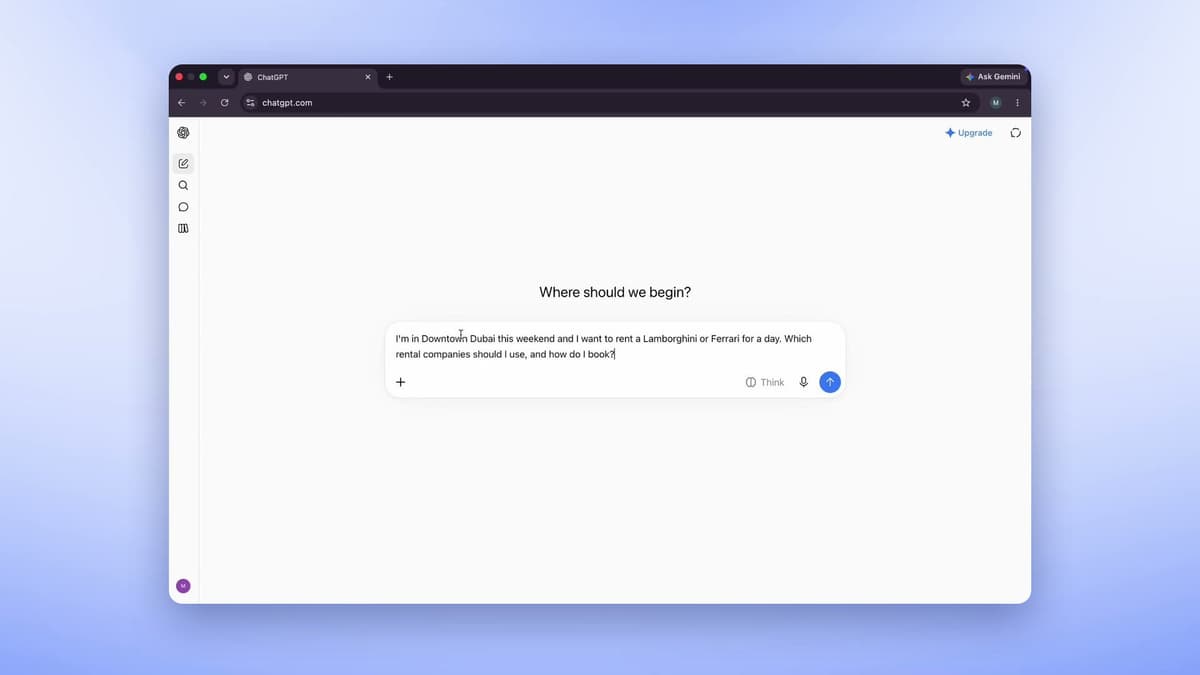
We watched it happen. The question we asked was:
I'm in Downtown Dubai this weekend and I want to rent a Lamborghini or Ferrari for a day. Which rental companies should I use, and how do I book?
ChatGPT turned that into two separate searches:
best Lamborghini Ferrari rental companies Dubai Downtown Dubai booking requirements 2026official UAE tourist driving licence requirements rent a car international driving permit Dubai 2026
Two things stand out. It injected the location ("Downtown Dubai") and the current year ("2026"), and the second search was more specific, fired after it read the first results. OpenAI describes exactly this follow-up behavior. The practical point: your page competes for the rewritten query, not for the customer's original phrasing.
Finding 2: it reads the live web, not its memory
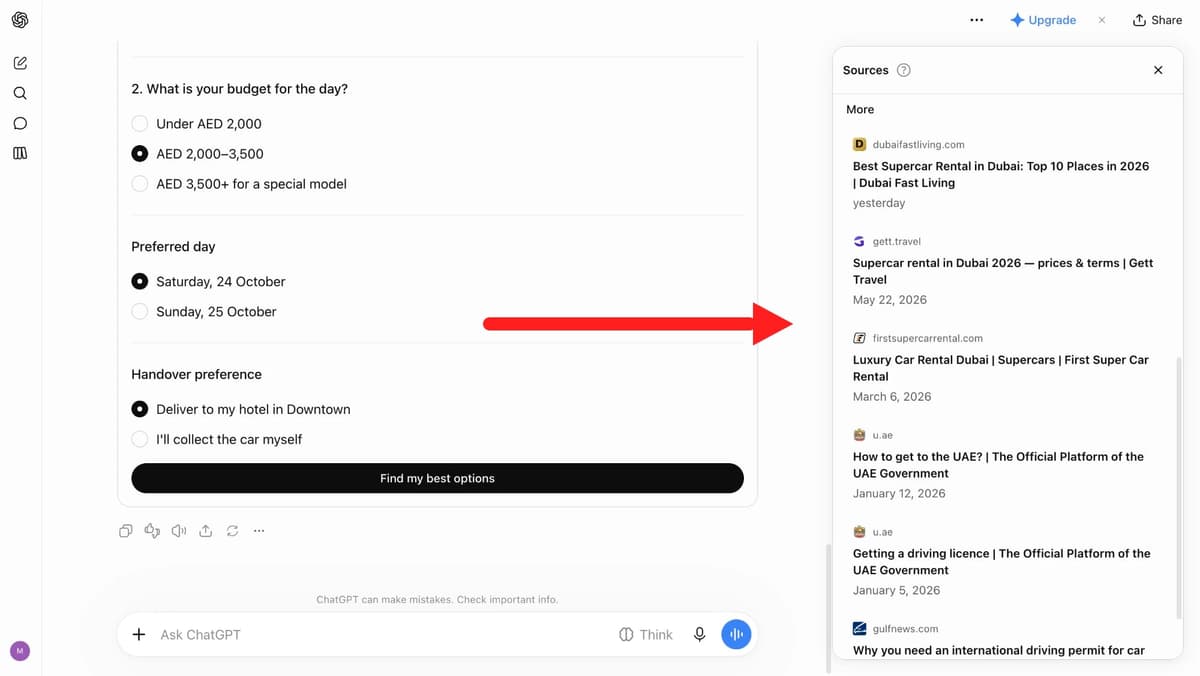
For that single question, ChatGPT searched about 25 websites across two rounds. The search partner it uses is Microsoft (Bing), alongside OpenAI's own search index, which is built by OpenAI's crawler, OAI-SearchBot. OpenAI's help page links Microsoft's privacy policy as the search provider, and OpenAI's bot documentation describes OAI-SearchBot as the crawler that makes a site eligible to appear in ChatGPT search. The exact balance between OpenAI's own index and Bing is not published, and we do not guess it.
One detail worth knowing: every link ChatGPT returned carried ?utm_source=chatgpt.com. That means you can measure ChatGPT referral traffic in your own analytics, with no extra setup.
Finding 3: for a local business, ChatGPT uses two systems at once
Our captured data showed ChatGPT did not only run plain web searches. For the local businesses it recommended, it also pulled structured listings that look like Google Maps data. Each record had a rating, a review count, a phone number, opening hours, and an internal ranking score. Examples from our capture:
Business | Rating | Reviews | Internal ranking score |
|---|---|---|---|
Superior Car Rental | 4.7 | 4,474 | 0.99999 |
Uptown Rent a Car | 4.9 | 2,941 | 0.99917 |
EXOTIX Drive | 5.0 | 61 | 0.97766 |
So a business can enter a ChatGPT answer through the open web (its own site, a review listicle) or through a map and local listing carrying ratings and reviews. For local queries, both doors are open at the same time.
Finding 4: where your information comes from depends on your market
This is the core result. We tested two very different markets, and the sourcing was not the same.
Saturated market: supercar rental in Dubai
The companies ChatGPT recommended were backed by a mix: Google Maps listings with high review counts, third-party "best of" articles (for example a "7 Best Supercar Rental Companies" piece and a "Top 10 Places 2026" list), and in some cases the company's own website. In a crowded market with lots of coverage, no single source dominated.
Niche market: a sales-funnel web-design agency
We asked ChatGPT to compare Dubai web-design firms that specialize in sales funnels. It built a pricing comparison table and placed Funnelado, one of our most recent clients at Reddlix, first. The information came straight from the agency's own website: the published price and the feature description in ChatGPT's table matched the company's own site. With little third-party coverage to lean on, the business's own site was the source.
This matches an independent experiment by Ahrefs. For a brand-new brand, 82% of its new AI mentions appeared in answers that cited the brand's own published pages. For an established brand, 94% came from third-party content. The author is careful to add that "This isn't proof," and that getting cited did not always lead to being recommended.
The plain takeaway: if you are new or niche, your own website is very likely the source ChatGPT uses, so it has to be clear, current, and crawlable. If your market is crowded, third-party coverage and your local listing carry more of the weight.
Finding 5: the recommendation is stable, not random
Across our repeated runs of the same question, ChatGPT recommended largely the same set of companies, with some variation from run to run. That tells us two things. A recommendation is a position you can earn and hold, not a coin flip. And a single screenshot proves nothing: because the answer moves, you have to measure across several runs before you trust a result.
Finding 6: different engines, different winners
We asked Perplexity the exact same supercar question. It recommended almost entirely different companies. The only company that appeared on both sides was Mey Car Rental, and even then ChatGPT listed it only among its sources, not as a top pick.
The sourcing pattern differed too. Perplexity cited each company's own website: five of its six picks were cited by the company's own domain. ChatGPT, as shown above, mixed Google Maps listings and third-party lists. There is no "optimize once, win everywhere." The lesson is to work the levers each engine actually uses.
What happens under the hood, from the official docs
OpenAI separates three jobs, and the settings are independent:
GPTBot collects content that may be used to train OpenAI's models.
OAI-SearchBot builds the search index that makes a site eligible to appear in ChatGPT search.
ChatGPT-User fetches a page live when a user action requires it.
On eligibility and ranking, OpenAI is explicit: "ChatGPT ranks search results using multiple factors intended to help users find relevant, reliable information. Placement is not guaranteed. To make a website eligible for inclusion, allow OAI-Searchbot to crawl the site and confirm that the website host or content delivery network allows traffic from OpenAI's published searchbot IP addresses."
Perplexity and Anthropic describe the same shape. Perplexity runs a search crawler (PerplexityBot) plus a user-triggered fetcher (Perplexity-User), neither used for training. Anthropic states that "Claude can now search the web to deliver up-to-date, cited information," with direct citations when it uses the web.
What this means for your business
Framed as what the evidence supports, not as promises:
Make your own website the clear source of truth. For a new or niche business it is, in practice, the source ChatGPT uses. Keep prices, services, and location current and specific.
Be crawlable by OAI-SearchBot. Do not block it in robots.txt, and make sure your host or CDN allows OpenAI's searchbot IP addresses. If a model's crawler cannot read you, you cannot be surfaced.
Write for the rewritten query, not the customer's phrasing. Name the city or area, the current year, and the specific thing (the model, the service, the requirement). That is the language ChatGPT actually searches for.
Keep your Google Business Profile strong. For local answers, ChatGPT uses map listings with ratings and review counts.
In crowded markets, earn third-party coverage. "Best of" lists and editorial carry weight where your own site competes with many others.
Do not optimize for one engine only. ChatGPT and Perplexity reward different things.
Remember that being cited is not the same as being recommended. Aim to be the believable answer to the question, not just a footnote in the sources.
You can watch it happen in your own server logs
You do not have to guess when AI systems reach your site. You can read it in real time and build an index of when ChatGPT, or any AI, visits you, straight from the user-agent in your own server logs. Each system identifies itself with a distinct User-Agent string: OpenAI sends ChatGPT-User for the live fetch it makes while answering, OAI-SearchBot for its search-index crawl, and GPTBot for training; Perplexity sends PerplexityBot and Perplexity-User. Filter your access logs on those agents and you can see which AI read which page, and how often. Turning that raw crawler activity into actionable statistics is exactly the work our experts at Reddlix do.
Limitations
AI answers are non-deterministic and are shaped by location and account. We used a clean state and repeated runs.
The internal field we used to read ChatGPT's search queries is undocumented and could change or disappear. We triangulated it with the visible sources and with Perplexity.
Tests were run from Dubai with model gpt-6. Results elsewhere, and with other models, may differ.
The exact split between OpenAI's own index and Bing is not published. We do not estimate it.
Conclusion
When a customer asks ChatGPT who to use, ChatGPT does not remember you. It rewrites the question, searches the live web and local listings, ranks what it finds, and cites a few sources. Where your information comes from depends on how crowded your market is, and the engines do not agree with each other. The center of gravity, across every test we ran, is your own website: clear, current, crawlable, and written for the question the model will actually search.
Sources
OpenAI, Searching the web with ChatGPT, OpenAI Help Center.
OpenAI, Overview of OpenAI crawlers (GPTBot, OAI-SearchBot, ChatGPT-User).
Andrej Karpathy, Deep Dive into LLMs like ChatGPT (YouTube, 2025), and "How I use LLMs" (Andrej Karpathy, YouTube, 2025).
Perplexity, Perplexity Crawlers documentation.
Anthropic, Claude can now search the web.
Ahrefs, Mateusz Makosiewicz, Self-Promotional Content Works Until It Backfires (AI SEO Experiment), 2026.
Primary data: our own captured ChatGPT and Perplexity sessions, Dubai, October 2026.